
Bullying is one of the greatest concerns a parent can have for their child.
We want our children to feel safe, confident and capable of handling difficult situations—but we do not want them to become aggressive or believe that fighting is the answer to every problem.
So, can martial arts genuinely help?
The honest answer is yes—but not simply because a child learns how to punch, kick, grapple or defend themselves. The greatest protection martial arts may provide is often the confidence, awareness and composure developed long before a confrontation becomes physical.
Research into martial arts and children is still developing, and no responsible club should promise that training will prevent bullying completely. However, studies have identified potential benefits involving self-confidence, self-control, emotional regulation and psychological wellbeing when martial arts is taught within an appropriately structured environment.
What Is Bullying?
Not every disagreement between children is bullying. Friends fall out, children argue and isolated incidents sometimes happen.
According to UK Government guidance, bullying is commonly understood as behaviour that is:
- Repeated
- Intended to hurt someone physically or emotionally
- Often aimed at a particular person or group
The Anti-Bullying Alliance also describes bullying as the repetitive, intentional hurting of one person or group by another, where the relationship involves an imbalance of power.
That power might come from:
- Physical size or strength
- Popularity or social influence
- The support of a larger group
- Access to private or embarrassing information
- Age, status or perceived authority
- Greater confidence within a particular situation
Bullying can be physical, verbal, social or online. It may include hitting, pushing, threats, name-calling, spreading rumours, deliberate exclusion or sending abusive messages.
What Are the Characteristics of Bullying Behaviour?
There is no single personality type or background that identifies a child who may bully others.
The available evidence shows that young people involved in bullying do not fit neatly into one category. Some are socially confident and well connected, while others may be isolated, insecure or experiencing bullying themselves. The US Government’s StopBullying.gov research summary stresses that there is no single profile of a young person who bullies.
It is therefore more useful to recognise characteristics within the behaviour itself:
- Seeking power or control over another person
- Testing boundaries to discover what they can get away with
- Choosing situations where they hold an advantage
- Using an audience to increase embarrassment or humiliation
- Encouraging others to join in or remain silent
- Repeating behaviour after seeing that it causes distress
- Disguising harmful conduct as “banter” or “just a joke”
- Blaming the other child for provoking the behaviour
- Using strength, popularity or private information as leverage
- Separating a child from their friends or sources of support
Bullies rarely want a fair contest. Bullying normally depends upon an imbalance of power, whether that power is physical, social or psychological.
The intention is often to gain control, status or attention while facing as little resistance or consequence as possible.
Do Bullies Avoid Confident Children?
Children who appear confident, aware and prepared to speak up may sometimes present a less attractive target because they can appear harder to intimidate or control.
Confidence might be communicated through:
- Standing upright
- Remaining aware of the surroundings
- Speaking clearly and firmly
- Setting a verbal boundary
- Staying composed
- Moving towards friends or trusted adults
- Reporting inappropriate behaviour
- Refusing to provide the emotional reaction being sought
However, confidence does not guarantee that a child will never experience bullying.
Confident, popular and physically capable children can also be targeted, particularly through social exclusion, rumours, discriminatory bullying or online abuse.
Most importantly, bullying is always the responsibility of the person choosing to bully. A child must never be made to feel that they were targeted because they were not confident, strong or assertive enough.
Confidence should be viewed as one useful protective tool—not as a guarantee and certainly not as a reason to blame the child.
Martial Arts Confidence Is Earned
At New City Martial Arts, confidence is not something we simply tell children to have. It is something they gradually earn through experience.
A child learns a new technique, practises it, makes mistakes and eventually performs it successfully. They work with different partners, answer questions, accept coaching and overcome challenges that once felt uncomfortable.
Each small achievement provides evidence:
“I can learn.”
“I can improve.”
“I can stay calm when something is difficult.”
“I am more capable than I thought.”
That is real confidence. It is based on repeated experience rather than empty reassurance.
A broad review of martial arts research published in the Journal of Sports Science and Medicine found associations between martial arts participation and several social and psychological outcomes. It also noted that results can depend upon factors including the teaching style, the instructor and whether the environment emphasises respect, self-control and responsible behaviour.
A separate martial arts study published by BMC Psychology reported potential benefits for wellbeing and internalising mental health difficulties. The researchers also highlighted limitations within the wider evidence base, including small samples and differences between programmes.
In other words, martial arts itself is not magic. The quality, values and structure of the coaching matter.
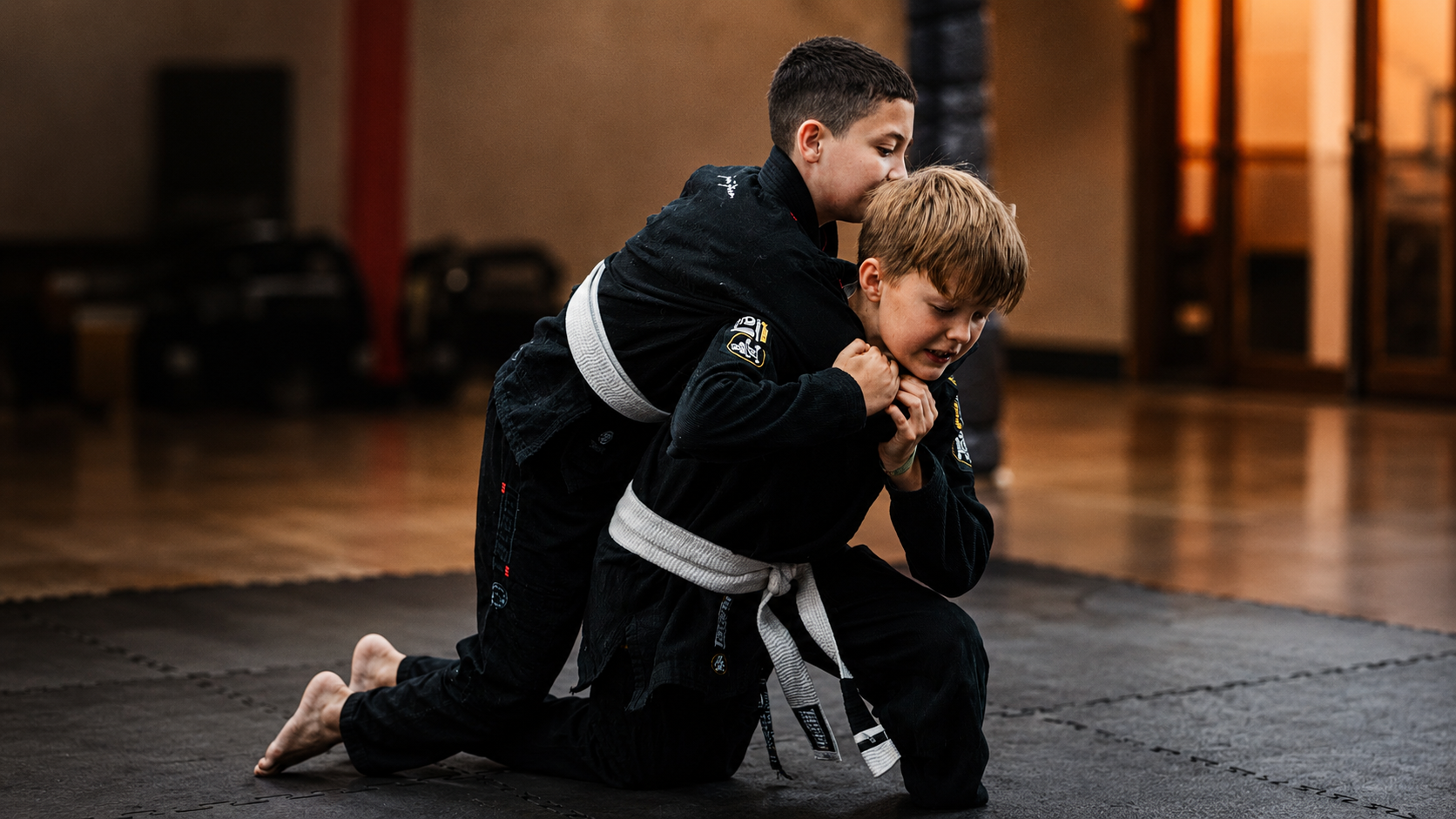
The Brazilian Jiu-Jitsu Superpower
Brazilian Jiu-Jitsu offers children a particularly valuable “superpower”: learning to remain calm, think clearly and solve problems while under controlled pressure.
A student may find themselves underneath a larger or stronger training partner. At first, the position can feel overwhelming. They cannot always rely on strength, panic or simply push their way out.
Instead, they learn to:
- Control their breathing
- Protect themselves
- Understand the position
- Create space
- Use leverage and timing
- Work through the correct escape
- Recover and try again
Over time, the child discovers that size and strength are not the only things that matter.
Knowledge, patience, positioning and composure can allow a smaller student to overcome the physical advantages of a larger opponent.
But the real superpower extends far beyond defeating someone physically.
It creates the developing belief that:
“Being under pressure does not mean I am powerless.”
Research specifically examining Brazilian Jiu-Jitsu remains limited, particularly among children, so exaggerated promises should be avoided. However, a recent study involving 420 adult practitioners found that greater BJJ experience was associated with characteristics including resilience, self-efficacy and self-control. The researchers also made clear that the study demonstrated an association—not proof that BJJ alone caused those differences. The full research is available through the National Library of Medicine.
On the mats, we see how this process can help children approach pressure differently.
They learn that they do not have to panic simply because a situation is uncomfortable. They can pause, protect themselves, assess the problem and choose their next action.
That same mindset can support them when facing:
- A difficult task at school
- Frustration when progress feels slow
- An uncomfortable conversation
- Social pressure
- A setback or disappointment
- Anxiety about trying something new
- An opponent who appears bigger or stronger
The Jiu-Jitsu superpower is not merely overcoming a larger person. It is recognising that a difficult position can be understood, managed and eventually escaped.
Physical Skills Should Be the Last Resort
Responsible martial arts training does not teach children to settle arguments by fighting.
A child should be encouraged to:
- Recognise potential danger early
- Avoid unnecessary confrontation
- Use a clear and confident voice
- Move away whenever possible
- Find a trusted adult
- Report what has happened
- Use physical skills only when necessary to protect themselves or escape
If physical danger cannot be avoided, martial arts training may provide useful skills such as protecting the head, maintaining balance, managing distance, escaping a grip or safely disengaging.
Brazilian Jiu-Jitsu can be especially useful because it teaches positional control, escapes and methods of managing physical pressure. A trained student may have more options than responding with uncontrolled punches.
The objective is not to prove toughness or “win a fight.”
The objective is to get safe.
Martial Arts Is Part of the Solution—not the Whole Solution
Joining a martial arts club should never replace speaking to the child’s school, documenting incidents or seeking appropriate professional support.
The Anti-Bullying Alliance’s parent and carer guidance recommends listening carefully, reassuring the child that telling someone was the right thing to do and making clear that the bullying is not their fault.
Parents should record:
- What happened
- Where it happened
- When it occurred
- Who was involved
- Whether anyone witnessed it
- How frequently it has happened
- Any messages, photographs or other evidence
Every school should have its own behaviour and anti-bullying policies. State schools are legally required to have measures designed to prevent bullying, as explained in the Government’s guidance on bullying and the law.
Serious incidents involving violence, assault, theft, repeated harassment, intimidation or hate crime may also constitute criminal offences. If a child or anyone else is in immediate danger, call 999.
Martial arts works best as one part of a wider response involving the child, parents, school and coaches.
More Than Self-Defence
The greatest benefit of martial arts is not creating children who are eager to fight.
It is helping to develop young people who are:
- Alert without being constantly afraid
- Confident without being arrogant
- Capable without being aggressive
- Calm when placed under pressure
- Willing to speak up for themselves and others
- Resilient enough to recover from setbacks
- Disciplined enough to use their skills responsibly
Studies examining martial arts and aggression have produced mixed results, demonstrating why the culture and teaching methods of a club are so important.
A 2024 school-based martial arts study found that its intervention neither reduced nor increased aggressive behaviour. Meanwhile, a broader review of the social and psychological outcomes of martial arts concluded that traditional values—including respect, self-control and conflict avoidance—may influence the results students experience.
That is why responsible coaching must teach character and judgement alongside physical technique.
We cannot promise that martial arts will prevent every child from experiencing bullying. Nobody should make that promise.
What we can do is help children develop:
- The confidence to establish boundaries
- The awareness to recognise danger
- The courage to ask for help
- The composure to think under pressure
- The physical ability to protect themselves when there is no safe alternative
That is the real power of martial arts—and the Brazilian Jiu-Jitsu superpower extends far beyond overcoming a bigger opponent.
It teaches children that difficult does not mean impossible, pressure does not have to produce panic and feeling vulnerable does not mean being powerless.
Help Your Child Discover What They Are Capable Of
New City Martial Arts provides structured Kickboxing and Brazilian Jiu-Jitsu training for children in Milton Keynes.
Our classes help students develop confidence, discipline, resilience, fitness and practical skills within a supportive and appropriately controlled coaching environment.
Places are limited, so we recommend arranging a free trial as soon as possible:
View the NCMA timetable and book a free trial
Sources and Further Reading
- UK Government: Definition of bullying
- UK Government: Bullying at school and the law
- Department for Education: Preventing and tackling bullying
- Anti-Bullying Alliance: Definition of bullying
- Anti-Bullying Alliance: Advice for parents and carers
- StopBullying.gov: What is bullying?
- Journal of Sports Science and Medicine: Social and psychological outcomes of martial arts practice
- BMC Psychology: Martial arts participation and mental health outcomes
- National Library of Medicine: Psychological characteristics among Brazilian Jiu-Jitsu practitioners
About the Author
Coach Johnny Tomsett is the Director and Head Coach of New City Martial Arts in Milton Keynes. With more than three decades of martial arts experience, he coaches children, teenagers and adults in Kickboxing and Brazilian Jiu-Jitsu, with a strong emphasis on confidence, discipline, practical skills and responsible behaviour.
Frequently Asked Questions
Can martial arts stop my child from being bullied?
No activity can guarantee that a child will never experience bullying. Martial arts can, however, help children develop confidence, awareness, composure, assertive communication and practical options for protecting themselves.
Will learning martial arts make my child aggressive?
Responsible training should emphasise self-control, respect and avoiding unnecessary confrontation. The culture of the club and quality of the coaching are therefore extremely important.
Which is better for confidence: Kickboxing or Brazilian Jiu-Jitsu?
Both can build confidence in different ways. Kickboxing develops movement, coordination, controlled striking and distance management. Brazilian Jiu-Jitsu teaches students to solve physical problems, use leverage and remain composed under pressure.

